Why Skill Development Is the Foundation of a Safer Indian Workforce
- India’s Industrial Growth Needs Skilled Workers
- Safety and Sustainable Development Go Hand in Hand
- India’s Regulatory Landscape Has Changed: Skills Must Keep Pace
- Closing India’s Persistent Skill Gap: SSDF’s Role
- Skilled Workers Prevent Incidents Before They Happen
- Why NCVET Certification Matters
- India’s Demographic Dividend Needs Safety Skills
- A Safety Culture Is Built, Not Installed
- Why SSDF Is Leading India’s Safety Skill Development
- Frequently Asked Questions
India’s Industrial Growth Needs Skilled Workers
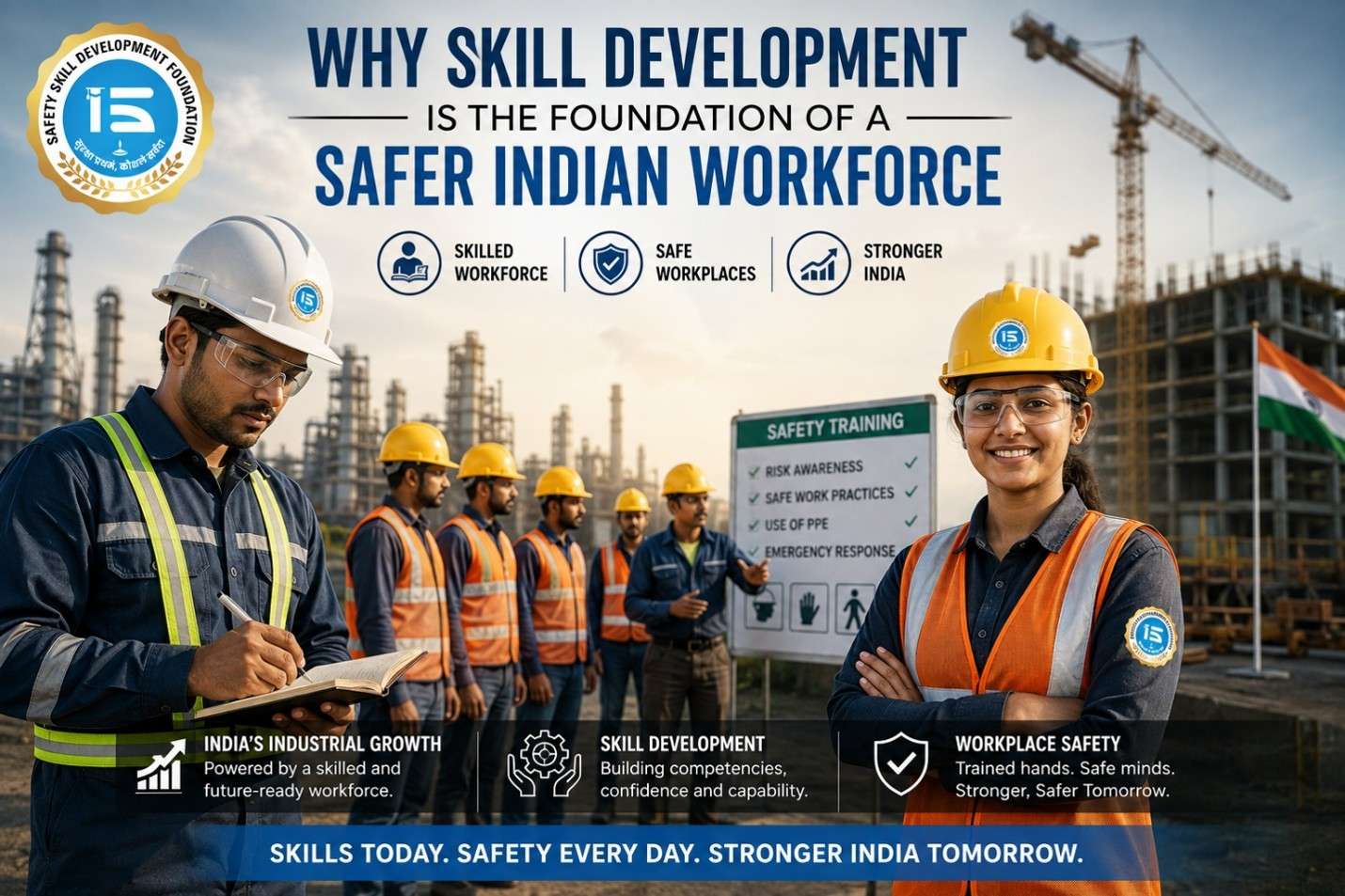
India’s industrial growth story is impressive by almost any measure: expanding manufacturing, booming construction, a rapidly scaling logistics sector, and a young workforce entering these industries in the millions each year. But scale without skill is a risk multiplier, not a growth engine. A worker who hasn’t been trained to read a permit-to-work system, inspect a scaffold, or respond to a chemical spill isn’t just underprepared; they’re a safety incident waiting to happen.
This is why skill development can’t be treated as an add-on to workplace safety in India. It is workplace safety. And as industries evolve and the economy expands, that connection is only getting stronger, which is exactly the gap the Safety Skill Development Foundation (SSDF) was built to close.
Safety and Sustainable Development Go Hand in Hand
Across the world, organizations are aligning their work with the United Nations Sustainable Development Goals (SDGs), a framework built to promote shared prosperity while protecting people and the planet. Achieving that kind of prosperity in a country growing as fast as India requires more than economic output. It requires skilled professionals, safe workplaces, environmentally responsible practices, and systems that keep people learning throughout their careers.
Occupational safety and skill development sit directly at that intersection. Every properly trained worker represents a workplace accident that didn’t happen, a compliance failure that was avoided, and one more person contributing productively rather than becoming a statistic. This is the quiet mechanism by which SSDF’s skilling programs move the needle on national development; not through slogans, but through fewer incidents on the ground.
India’s Regulatory Landscape Has Changed: Skills Must Keep Pace
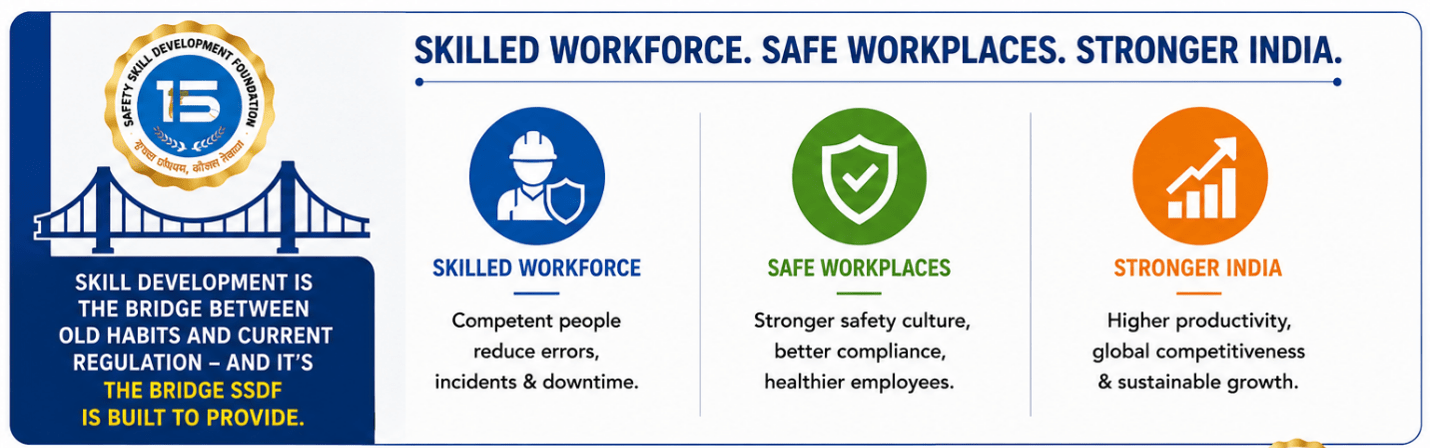
India’s labour reform journey recently reached a major milestone with the nationwide implementation of four consolidated labour codes. Among them, the Occupational Safety, Health and Working Conditions (OSH) Code, 2020 marks the most significant shift yet for organizations focused on workplace safety and EHS compliance, replacing a patchwork of older regulations with a single, more enforceable framework. For employers, this isn’t just a paperwork update. I
t means the people responsible for safety on the ground- supervisors, inspectors, executives need updated, standardized skills to meet a modernized compliance bar. A workforce trained under outdated methods can’t reasonably be expected to operate under new law. Skill development is the bridge between old habits and current regulation, and it’s the bridge SSDF’s NCVET-recognized qualifications are specifically designed to build.
Closing India’s Persistent Skill Gap: SSDF’s Role
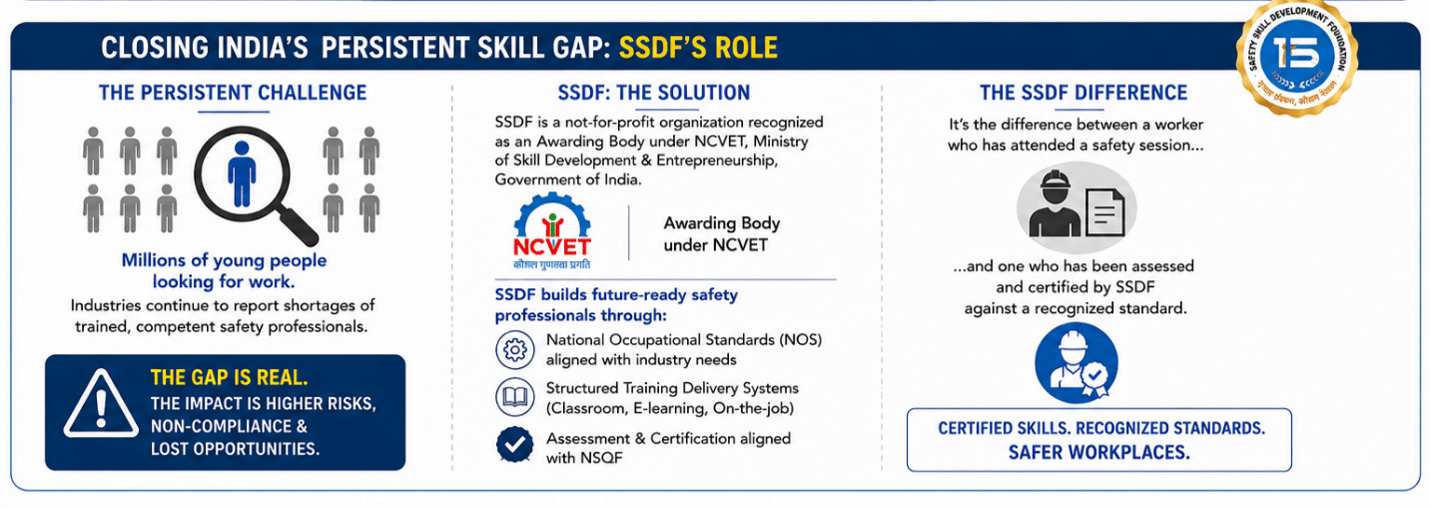
India has long faced a structural mismatch: millions of young people looking for work, while industries continue to report shortages of trained, competent safety professionals. This is precisely the gap SSDF was built to close.
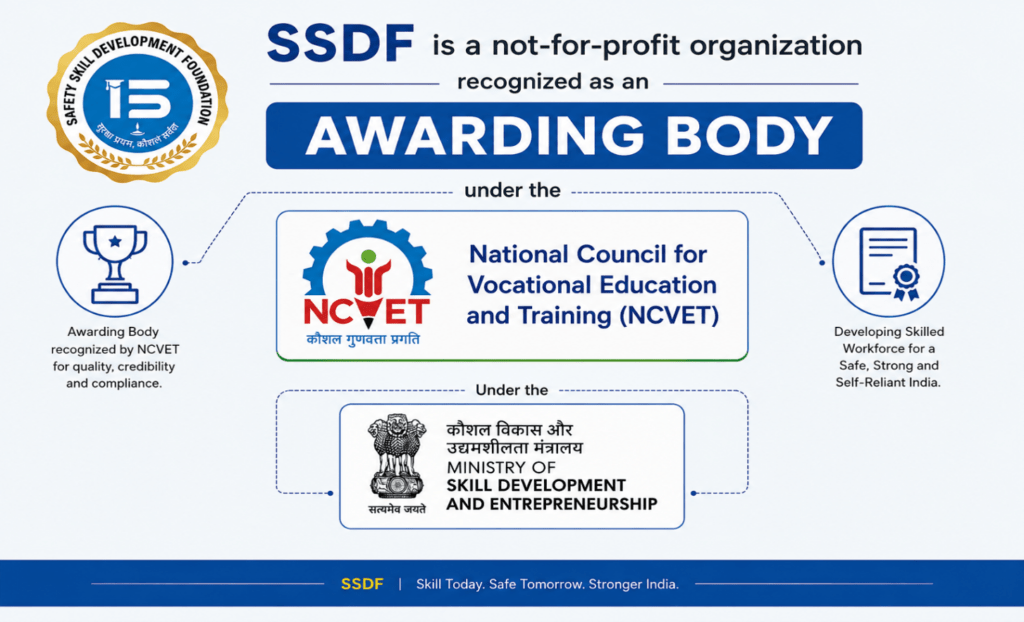
SSDF is a not-for-profit organization recognized as an Awarding Body under the National Council for Vocational Education and Training (NCVET), Ministry of Skill Development & Entrepreneurship, Government of India. Rather than offering generic training, SSDF develops internationally acceptable National Occupational Standards (NOS), structured training delivery systems, and assessment and certification processes aligned with the National Skill Qualification Framework (NSQF). That distinction matters: it’s the difference between a worker who has attended a safety session and one who has been assessed and certified by SSDF against a recognized standard.
Skilled Workers Prevent Incidents Before They Happen
Most workplace accidents aren’t bad luck; they’re gaps. A hazard that wasn’t identified. A control measure that wasn’t applied. A process nobody was trained to follow.
A properly trained Safety Supervisor knows how to scrutinize an organization’s safety processes to spot inefficiencies and loopholes before they cause harm. A trained Safety Executive knows how to implement health and safety policy, identify hazards on the shop floor, and advise management on maintaining safe working conditions, rather than reacting only after something has already gone wrong. This is the practical payoff of structured skill development: it turns safety from a reactive checklist into a habit built into how people actually work.
Why NCVET Certification Matters
A recognized, NCVET-aligned qualification does two things simultaneously. For workers, it validates real, independently assessed competence rather than just years on the job, opening doors to better roles, higher pay, and even international placement opportunities as safety professionals. For employers, it de-risks hiring: a certified Safety Supervisor or Safety Executive is a known, benchmarked quantity rather than a gamble.
This is where formal skilling frameworks- built on occupational standards, structured curricula, and independent assessment bodies- matter far more than informal, one-off training sessions ever could. Over time, SSDF’s ecosystem has produced measurable results: over 60,000 professionals have been certified across construction, manufacturing, healthcare, logistics, energy, agriculture, and public services, each now equipped to identify hazards and enforce compliance in real workplaces.
India’s Demographic Dividend Needs Safety Skills
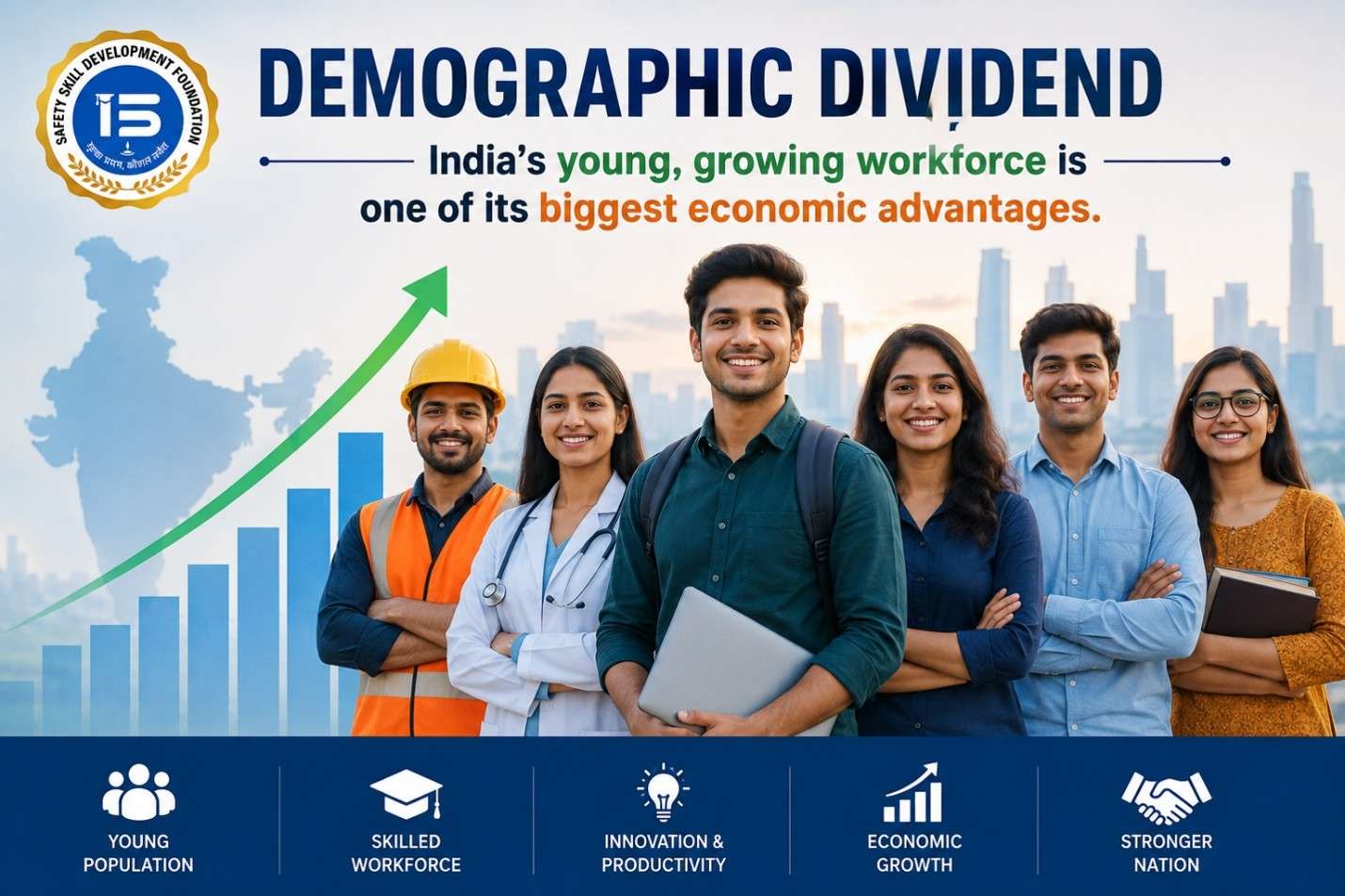
India’s young, growing workforce is one of its biggest economic advantages, but that advantage only compounds if workers are both employable and safe. A large labour pool without adequate safety skilling doesn’t reduce risk; it simply spreads that risk across more people, more sites, and more sectors. Structured skill development is what converts India’s demographic strength into a genuine, durable competitive advantage rather than a liability hidden inside the growth numbers.
A Safety Culture Is Built, Not Installed
Technology, PPE, and policy documents all play a role, but none of them build a safety culture on their own. Culture is built by people who understand why a rule exists, not merely that it exists. Skilling programs that go beyond rote compliance, teaching workers and supervisors to identify hazards, escalate unsafe conditions, and actively champion safety are what actually change behavior when no one is watching.
This is also where partnerships matter. SSDF’s growth has relied on collaboration with training organizations, industry bodies, including partners such as ONGC and assessment agencies, keeping its curricula relevant to real industrial conditions rather than static, one-size-fits-all modules that go stale as regulations and technologies evolve.
Why SSDF Is Leading India’s Safety Skill Development
India cannot scale its industrial ambitions responsibly without scaling its safety skills at the same pace. Structured, recognized skill development, spanning roles from Safety Supervisor to Safety Executive to specialized inspectors, isn’t a compliance formality. It is the foundation that makes rapid industrial growth sustainable, and it’s the difference between a workforce that merely works and one that works safely. This is the work SSDF has committed itself to for the past five years, and continues to build on today.
FAQs
Why is skill development important for workplace safety?
Skill development equips workers with the knowledge, practical skills, and safe work practices needed to identify hazards, follow procedures, prevent accidents, and comply with workplace safety regulations.
What is SSDF?
The Safety Skill Development Foundation (SSDF) is a not-for-profit organization recognized as an Awarding Body under NCVET, Ministry of Skill Development & Entrepreneurship, Government of India. SSDF develops National Occupational Standards, training systems, assessments, and certifications for workplace safety professionals.
What is NCVET and why is it important?
The National Council for Vocational Education and Training (NCVET) regulates vocational education and recognizes awarding bodies to ensure nationally accepted standards for skill development, certification, and quality assurance.
How does skill development reduce workplace accidents?
Properly trained workers can identify hazards, use PPE correctly, follow standard operating procedures, conduct risk assessments, and respond effectively during emergencies, significantly reducing workplace incidents.
What are the benefits of an NCVET-recognized safety certification?
NCVET-recognized certifications validate competency, improve employability, support career growth, help employers recruit qualified professionals, and strengthen regulatory compliance.
Which industries benefit from safety skill development?
Safety skill development benefits construction, manufacturing, oil & gas, logistics, healthcare, mining, power, chemical, infrastructure, and public sector organizations where occupational safety is essential.
How does SSDF contribute to India's Skill India Mission?
SSDF supports the Skill India Mission by developing industry-aligned qualifications, National Occupational Standards (NOS), structured training systems, assessments, and certifications that create a skilled, safety-conscious workforce.