Beyond Training: Why India Needs a Complete Safety Competency Ecosystem
Introduction: Training vs Competence — The Bigger Question
- Is Safety Training Alone Enough?
- India’s Changing Industrial Landscape Needs Competent Safety Professionals
- Training, Skills and Competency Are Different
- Occupational Standards: The Foundation of Competency
- From Generic Training to Role-Based Qualifications
- Why Competent Trainers Matter
- Assessment Beyond Attendance
- The Role of Assessors in Quality and Credibility
- Micro-Credentials and Continuous Learning
- Why Industry Participation Is Essential
- Building the Complete Safety Competency Ecosystem
- SSDF’s Contribution to India’s Safety Competency Ecosystem
- The Way Forward: From Certificates to Demonstrable Competence
- Conclusion: Safer Industries Begin with a Strong Competency Ecosystem
Frequently Asked Questions
From Qualifications and Micro-Credentials to Trainers, Assessors, and Industry Partnerships: Building the Complete Architecture of Industrial Safety
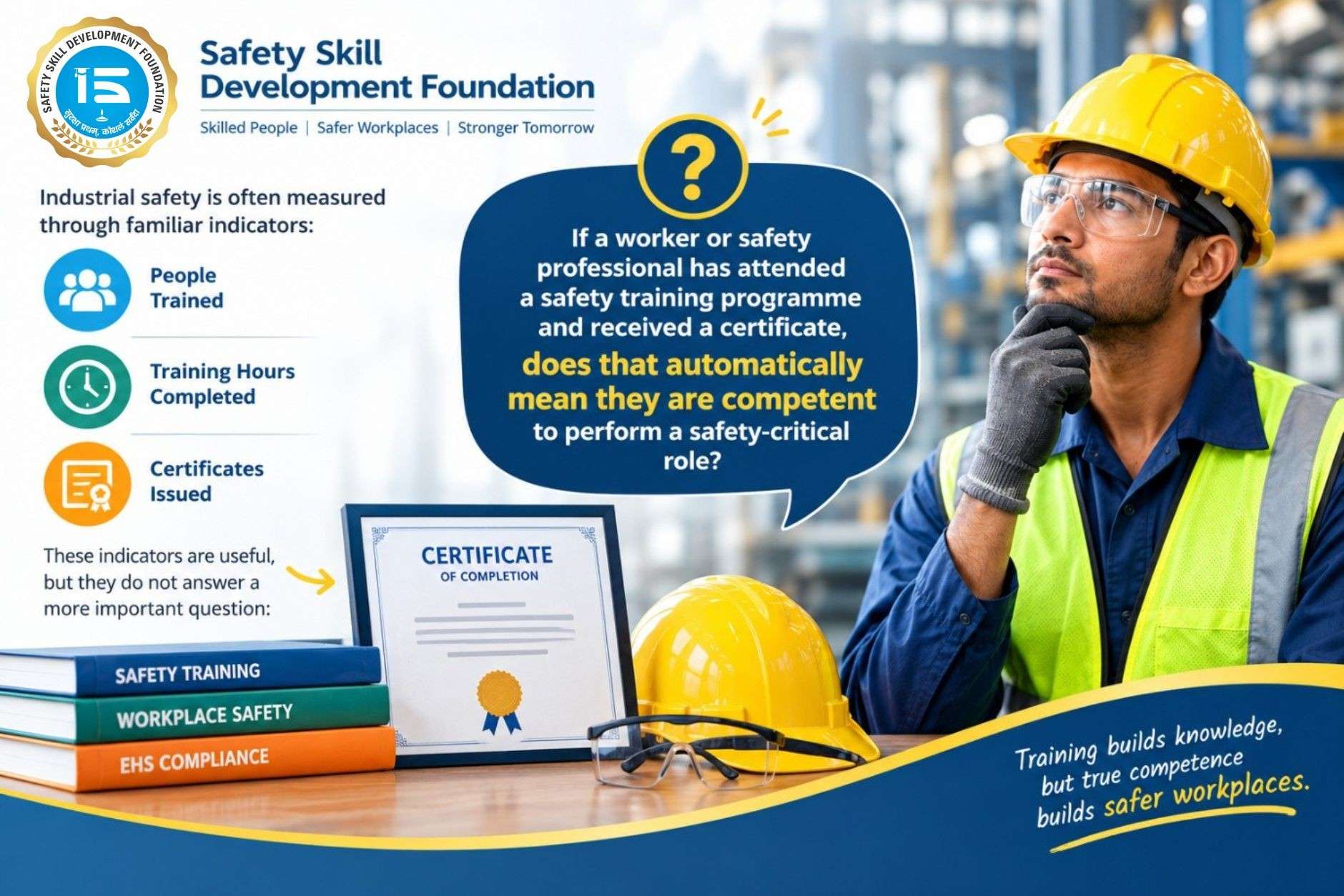
Industrial safety is often measured through familiar indicators: the number of people trained, training hours completed, or certificates issued. These indicators are useful, but they do not answer a more important question:
If a worker or safety professional has attended a safety training programme and received a certificate, does that automatically mean they are competent to perform a safety-critical role?
For India, this question is becoming increasingly important. Manufacturing, construction, infrastructure, energy and other sectors are expanding and evolving, while technology, new work processes and changing employment patterns are creating new skill requirements. Government policy is also placing greater emphasis on demand-driven and industry-aligned skilling.
The challenge, therefore, is not simply to train more people. It is to build a system that can define, develop, assess, and continuously strengthen the competencies required for safer workplaces.
1. Is Safety Training Alone Enough?
Safety training is essential. It provides workers and professionals with knowledge of hazards, procedures, equipment, and preventive measures. But training attendance and workplace competence are not the same thing.
India’s revised National Skills Qualification Framework (NSQF), notified on 6 June 2023, is an outcome and competency-based framework. It organises qualifications around levels of knowledge, skills, aptitude and responsibility, defined through learning outcomes and subject to assessment.
This distinction matters. Training provides an opportunity to learn. Skills enable a person to perform specific tasks.
Competence concerns the proven ability to apply knowledge and skills while carrying out assigned responsibilities.
In industrial safety, the ultimate question should therefore go beyond “Was the person trained?” to ask: Can the person perform the required safety role to the expected standard?
The Ministry of Labour & Employment’s National Policy on Safety, Health and Environment at Workplace similarly refers to increasing both the number and competence of personnel engaged in occupational safety, health and environment.
2. India’s Changing Industrial Landscape Needs Competent Safety Professionals
India’s workforce and industrial ecosystem are undergoing significant change. Government initiatives are strengthening manufacturing, infrastructure, apprenticeships, vocational education and technology-enabled skilling.
The Skill India Programme has been restructured around a more integrated approach that includes short-term skilling, on-the-job training and industry-aligned learning. The government’s broader direction is clear: workforce development must respond to changing industry requirements.
For industrial safety, this means competency requirements cannot remain static. A modern workplace may require professionals who can understand not only traditional hazards but also changing technologies, complex work processes, ergonomics, construction risks, traffic management and sector-specific safety requirements. As industries diversify, the idea that one generic safety course can prepare every individual for every safety responsibility becomes increasingly difficult to justify.
3. Training, Skills and Competency Are Different
A stronger safety ecosystem begins with understanding these differences.
- Training is the process through which learning is delivered. Knowledge concerns facts, principles, procedures and technical understanding.
- Skills concern the ability to perform particular tasks.
- Competence concerns the proven ability to apply knowledge and skills while carrying out responsibilities to the required standard.
This distinction is particularly important for safety-critical roles. A person may understand the principles of working at height but still require practical capability to identify unsafe conditions. A person may know the theory of scaffold safety but require specialised competence to inspect a scaffold against applicable specifications.
The objective of a safety system should therefore be more than course completion. It should be the development of capabilities linked with actual workplace responsibilities.
4. Occupational Standards: The Foundation of Competency
Before an individual can be assessed as competent, the expected competency must first be defined. This is where occupational standards and clearly defined job roles become important.
National Occupational Standards (NOS) describe the standards of performance and learning outcomes required for specific workplace functions. They provide a common reference for what an individual should know and be able to do.
For industrial safety, clearly defining roles is essential because different responsibilities require different competencies. A Safety Steward, Safety Supervisor, Safety Inspector and Scaffold Inspector do not perform identical functions. Their responsibilities, levels of technical knowledge and expected performance differ.
For example, SSDF’s Basic Scaffold Inspector qualification identifies responsibilities related to scaffold inspection, compliance with design and relevant specifications and ensuring scaffold safety for use. Such a role requires defined and specialised competence rather than general safety awareness alone.
5. From Generic Training to Role-Based Qualifications
The next step is to translate occupational requirements into structured qualifications.
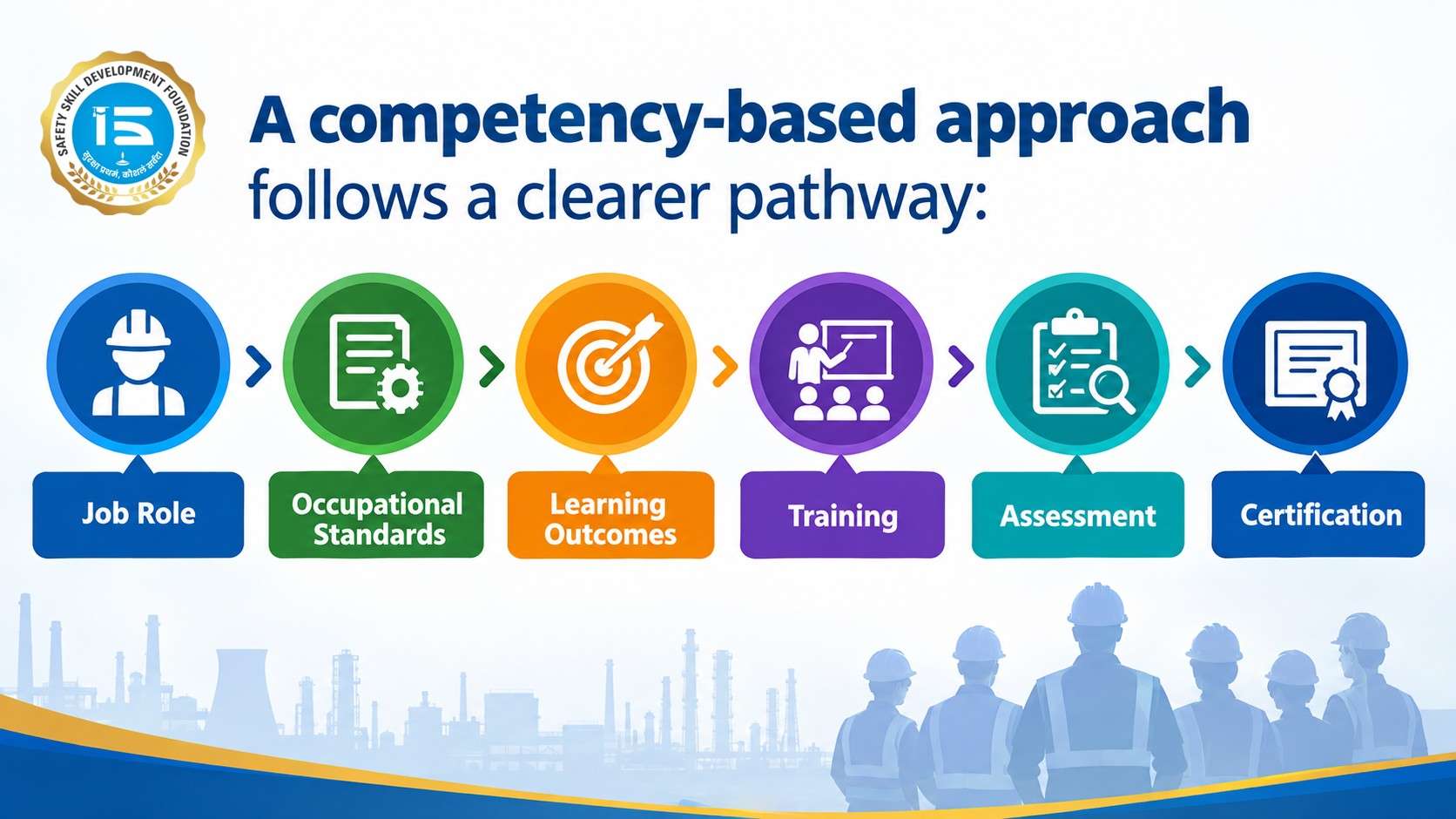
This approach allows training to be linked with the actual functions an individual is expected to perform.
SSDF’s qualification ecosystem reflects this role-based approach. Its published qualifications include specialised roles such as Safety Steward, Safety Supervisor (OSHE), Safety Inspector (OSHE) and Basic Scaffold Inspector.
Role-based qualifications do not eliminate the value of general safety awareness. Instead, they recognise that specialised responsibilities require specialised learning outcomes.
This is particularly relevant as industrial safety becomes more complex and sector-specific.
6. Why Competent Trainers Matter
A qualification is only as effective as the way it is delivered.
Trainers play a critical role in translating standards and curriculum into actual learning. In safety education, this may involve explaining technical concepts, demonstrating practical procedures, interpreting workplace situations, and helping learners understand how requirements apply in real conditions.
A trainer therefore needs more than subject knowledge. Effective competency-based training may also require:
- Relevant technical or industry experience
- Understanding of occupational standards
- Ability to deliver practical learning
- Ability to connect theory with workplace application
- Understanding of learner assessment requirements
SSDF maintains defined trainer eligibility criteria for its qualifications and micro-credentials and has also conducted Training of Trainers (ToT) programmes.
This recognises an important reality: a competency ecosystem cannot be stronger than the people responsible for developing competency.
7. Assessment Beyond Attendance
Attendance measures participation. Assessment measures outcomes.
Under the NSQF framework, qualifications are linked to prescribed learning outcomes that are subject to assessment and validation. This is an important distinction for industrial safety.
Assessment should help determine whether an individual has achieved the required outcomes, not merely whether the individual completed a programme.
Depending on the qualification and role, assessment may involve:
- Knowledge-based evaluation
- Practical tasks
- Viva or oral assessment
- Workplace or field exercises
- Evaluation against defined performance criteria
For a safety role, the assessment process should be relevant to the responsibilities of that role.
The key question should be:
Can the individual demonstrate the capability required for the job?
8. The Role of Assessors in Quality and Credibility
If trainers develop capability, assessors evaluate whether the required outcomes have been achieved.
This makes assessor competence equally important.
Assessors need to understand:
- The job role being assessed
- Occupational standards
- Performance criteria
- Assessment methodology
- Evidence requirements
- Principles of fair and consistent assessment
The credibility of certification depends significantly on the quality of assessment.
SSDF publishes assessment manuals across a range of qualifications and micro-credentials and also undertakes Training of Assessors (ToA) and Training of Master Assessors (ToMA) initiatives.
A robust ecosystem therefore requires both capable trainers and competent assessors, because developing competence and evaluating competence are two different but connected functions.
9. Micro-Credentials and Continuous Learning
Not every safety competency requirement demands a long-duration qualification.
Modern workplaces often require focused learning related to specific hazards, activities or emerging requirements. This is where micro-credentials can play a complementary role.
SSDF currently offers micro-credentials in areas including:
- Basics of Occupational Hazards & Risk Management
- Basics of Risk Analysis & Accident Prevention Methods
- Safety and Health Requirements related to BOCW
- Safety Protocols for Construction Works
- Safety Requirements in Working at Height
Micro-credentials should not be viewed as replacements for comprehensive qualifications. Their value lies in addressing focused competency requirements and supporting upskilling and continuous learning.
This is important because safety competency cannot be treated as a one-time achievement. Work processes, technologies and risks change, and learning must keep pace.
10. Why Industry Participation Is Essential
Training systems cannot operate in isolation from workplaces.
Industry understands changing technologies, work processes, operational risks and competency gaps. Its participation can help ensure that qualifications and training remain relevant to real workplace requirements.
Industry can contribute by:
- Identifying emerging skill needs
- Supporting the development and validation of job roles
- Providing practical learning opportunities
- Sharing workplace expertise
- Giving feedback on workforce performance
The national Skill India framework itself emphasises demand-driven and industry-aligned workforce development.
SSDF’s recent collaborations and programmes with industry and institutions, including initiatives involving construction and EHS stakeholders, demonstrate the importance of connecting competency development with actual workplace requirements.
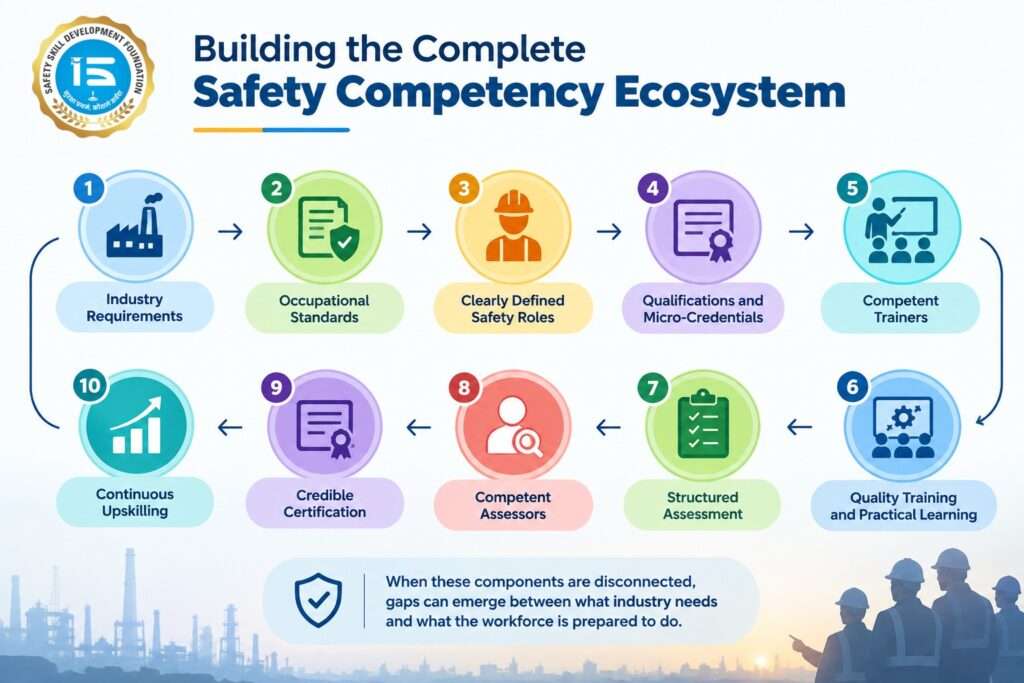
Building the Complete Safety Competency Ecosystem
11. SSDF’s Contribution to India’s Safety Competency Ecosystem
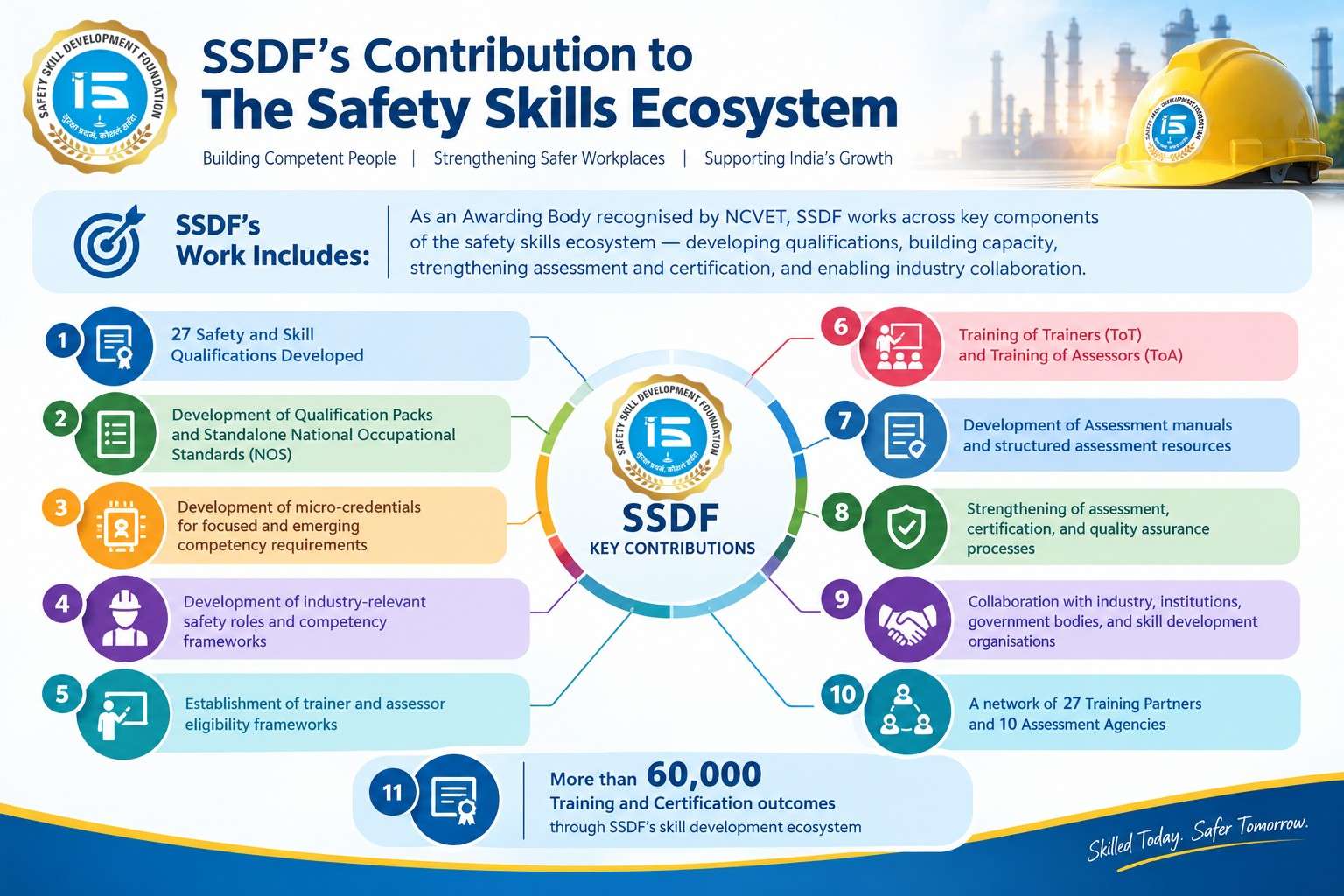
Safety Skill Development Foundation (SSDF), an Awarding Body recognised by NCVET, operates across several components of this ecosystem.
Its contribution includes:
SSDF’s Contribution to the Safety Skills Ecosystem
This approach is important because industrial safety cannot be strengthened through training delivery alone.
The ecosystem must address a broader question: What competency does industry require, how will it be developed, and how will achievement be assessed?
SSDF’s role is therefore not limited to one stage of the journey. Its work connects standards, qualifications, trainers, assessors, assessment and certification within the larger objective of strengthening safety capability.
12. The Way Forward: From Certificates to Demonstrable Competence
Certificates remain important because they can document the successful completion of a prescribed qualification or assessment process.
However, India’s industrial safety ecosystem must continue to focus on what certification represents.
The future discussion should increasingly focus on:
- Clearly defined competencies
- Role-specific learning
- Practical capability
- Quality trainers
- Reliable assessment
- Competent assessors
- Industry relevance
- Continuous upskilling
This is not an argument against training or certification.
It is an argument for ensuring that training and certification are part of a larger competency system.
The most important outcome is not simply the number of people who have completed a programme. It is whether the workforce has developed the capabilities required to perform safely and responsibly.
13. Conclusion: Safer Industries Begin with a Strong Competency Ecosystem
India’s industrial future will depend on technology, infrastructure, investment and skilled people. But as workplaces become more complex, industrial growth must be supported by equally strong systems for developing workplace competence.
Safety training remains the starting point. But training alone is not the complete architecture.
A stronger industrial safety ecosystem requires:
- Standards that define expectations.
- Qualifications that prepare people for specific roles.
- Micro-credentials that address focused and emerging needs.
- Trainers who can develop practical capability.
- Assessors who can evaluate learning outcomes fairly and consistently.
- Industry partnerships that keep competencies connected with workplace reality.
- Continuous learning that keeps the workforce prepared for change.
The central challenge is therefore not simply to move from fewer training programmes to more training programmes.
It is to move:
- From Attendance to Outcomes.
- From Certificates to Capability.
- And from Training to Demonstrable Competence.
For India to build safer workplaces, it needs more than isolated training interventions. It needs a complete safety competency ecosystem, and every part of that ecosystem must work together.
FAQs
What is the difference between safety training and safety competence?
Safety training provides an individual with knowledge and learning opportunities related to hazards, procedures, and preventive measures. Competence, however, is the proven ability to apply knowledge and skills effectively while performing a specific job or safety-related responsibility to the required standard.
Is receiving a safety certificate enough to prove competence?
Not necessarily. A certificate can demonstrate successful completion of a qualification, training programme or assessment process. However, for safety-critical roles, the more important question is whether the individual can demonstrate the knowledge, skills and practical capability required to perform the role safely.
Why are occupational standards important in industrial safety?
Occupational standards help define what a person should know and be able to do in a specific job role. They provide a foundation for developing qualifications, learning outcomes, training programmes and assessment criteria.
Why should safety qualifications be role-based?
Different safety roles have different responsibilities and competency requirements. A Safety Steward, Safety Supervisor, Safety Inspector or Scaffold Inspector may require different levels of technical knowledge, practical skills and responsibility. Role-based qualifications help align learning with actual workplace responsibilities.
What is the role of trainers in a competency-based safety ecosystem?
Trainers play an important role in converting occupational standards and curriculum into meaningful learning. In addition to subject knowledge, effective safety trainers need to connect theory with workplace situations, demonstrate practical procedures and support learners in developing job-related capability.
Why is assessment important beyond training attendance?
Attendance only confirms participation in a training programme. Assessment helps determine whether an individual has achieved the required learning outcomes and can demonstrate the capability expected for a particular role.
What are micro-credentials and how do they support safety professionals?
Micro-credentials provide focused learning opportunities related to specific skills, hazards or emerging competency requirements. They can support upskilling and continuous learning without replacing comprehensive, role-based qualifications.
How is SSDF contributing to India's safety competency ecosystem?
SSDF contributes across multiple stages of the safety skills ecosystem, including safety qualifications, Qualification Packs, National Occupational Standards, micro-credentials, trainer and assessor frameworks, ToT and ToA programmes, assessment resources, certification processes and collaboration with industry and institutions.